“What Is a City, If Not Its People?”: The Türkiye Design Foundation’s Revival Approach for Hatay and Adıyaman
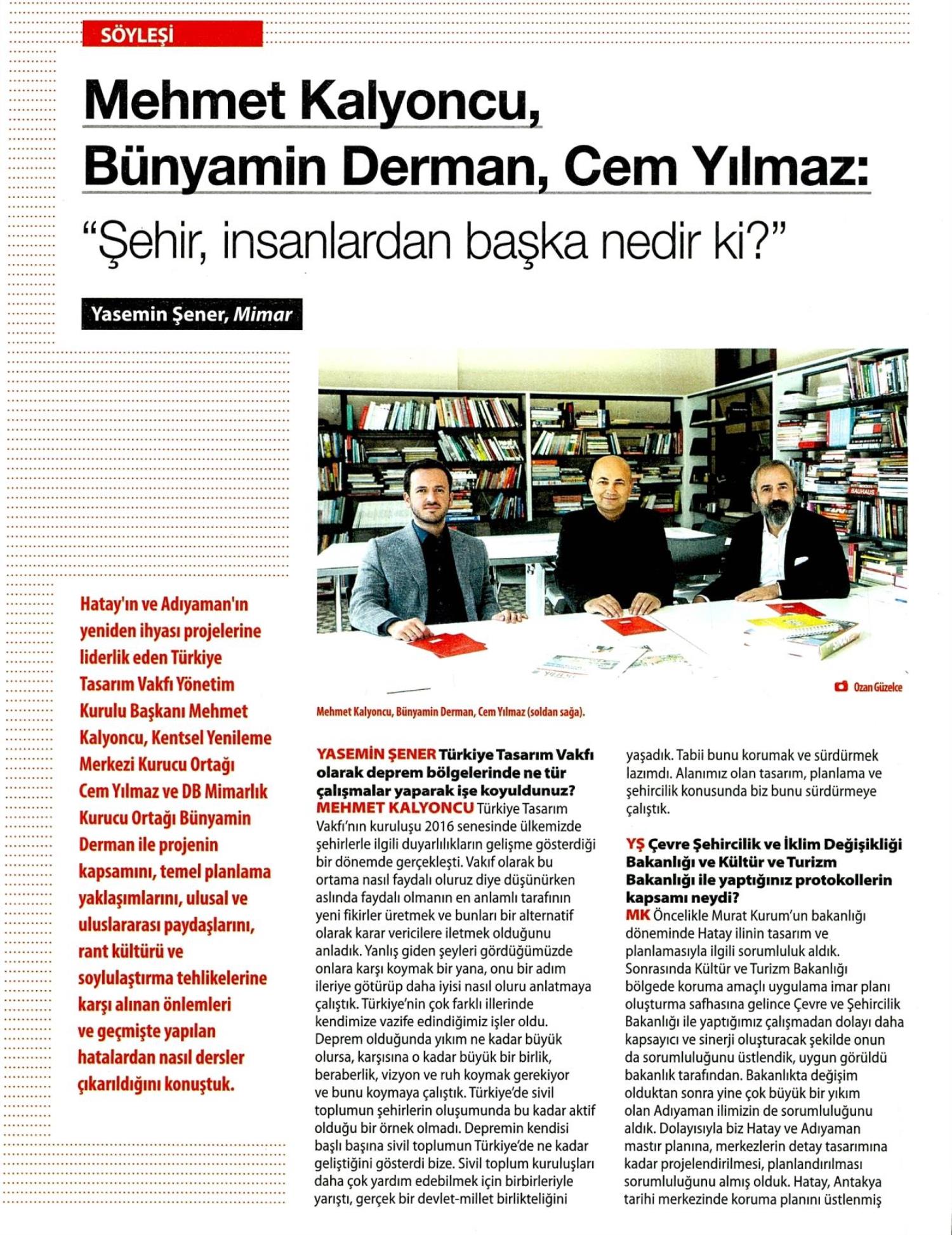
Mehmet Kalyoncu, Chairman of the Board of the Türkiye Design Foundation, Cem Yılmaz, Co-Founder of the Urban Renewal Center, and Bünyamin Derman, Co-Founder of DB Architecture, described the scope of the work for the post-earthquake revival of Hatay and Adıyaman and the core urban planning approach behind it.
The interview, conducted by architect Yasemin Şener, covered a wide range of topics, from the design and planning work in the earthquake zones and collaboration with public institutions to the preservation of historic urban fabric and the principles adopted in creating new cities.
What Role Has the Türkiye Design Foundation Taken On in the Earthquake Zone?
Mehmet Kalyoncu noted that the Türkiye Design Foundation was founded in 2016, at a time of growing public awareness about cities, and stated that the Foundation’s core approach is not only to generate new ideas but also to bring those ideas to decision-makers.
Pointing out that the massive destruction caused by the February 6 earthquakes called for strong unity, a shared vision and a comprehensive approach to planning, Kalyoncu emphasized that civil society in Türkiye should take a more active part in shaping cities.
Highlighting the importance of the solidarity that emerged after the earthquakes, Kalyoncu stated that it is important for different civil society organizations to act together and for the experience gained to be preserved and sustained.
Comprehensive Planning Work for Hatay and Adıyaman
The interview also addressed the work carried out under protocols with the Ministry of Environment, Urbanization and Climate Change and the Ministry of Culture and Tourism.
According to Mehmet Kalyoncu, the work began with the design and planning of Hatay. The scope of the project then expanded through the Ministry of Culture and Tourism’s conservation-oriented implementation zoning plan work in the region and the collaboration with the Ministry of Environment, Urbanization and Climate Change.
Adıyaman, which was also severely affected by the earthquakes, was subsequently included in the work. As a result, the Türkiye Design Foundation took on responsibility for a broad planning process for Hatay and Adıyaman, ranging from master plans to the detailed design of city centers, and from protecting historic areas to creating new living spaces.
Historic Fabric and Urban Culture Are Being Carried Into the Future
In the revival of Hatay and Adıyaman, the core elements of the project include not only constructing buildings but also preserving the cultural and social memory of the cities.
In discussing the scope of the project, the interview also touched on topics such as speculative development, the social structure of cities, lessons to be learned from past urban planning practices and how to create cities that are more resilient to disasters.
The Türkiye Design Foundation’s approach does not see post-earthquake reconstruction merely as a physical building process. The idea that cities must be considered together with their people, neighborhood culture, historic buildings and social life comes to the fore.
The approach “What is a city, if not its people?” sums up the fundamental perspective of the work. The projects prepared for Hatay and Adıyaman aim to preserve inherited values, restore the cities without losing their identities and leave more resilient living spaces for future generations.
Led by the Türkiye Design Foundation, the work sets out a comprehensive revival model that brings the public sector, civil society, architecture and urban planning together around a common goal.