Hatay Will Set an Example for the World: The Historic City Center Comes to Life With the Revitalization Project
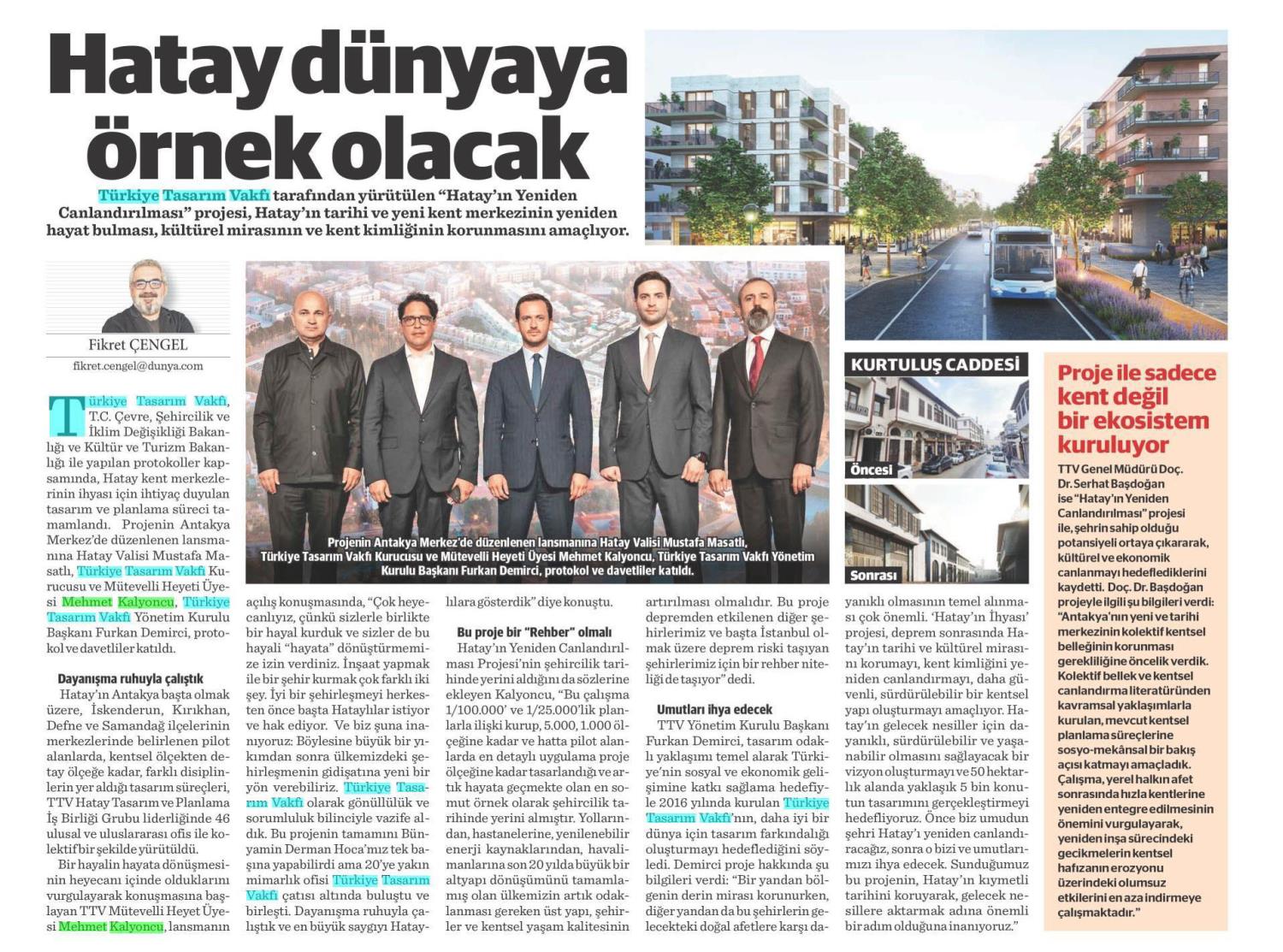
Work to restore Hatay after the February 6 earthquakes is continuing under the “Revitalization of Hatay” project. Carried out by the Türkiye Design Foundation, the project aims to bring Hatay’s historic and new city centers back to life, protect its cultural heritage and shape the city’s future with a more resilient approach to urban planning.
At the project’s launch in Antakya, carried out in cooperation with the Ministry of Environment, Urbanization and Climate Change and the Ministry of Culture and Tourism of the Republic of Türkiye, the design and planning work for Hatay’s future was shared with the public.
46 National and International Offices Came Together in the Project
The design processes in Hatay’s designated pilot areas, led by Antakya and including the districts of İskenderun, Kırıkhan, Defne and Samandağ, were developed with the participation of experts from different disciplines.
Led by the Türkiye Design Foundation’s Planning Collaboration Group, the work received contributions from 46 national and international design offices. Mehmet Kalyoncu, Member of the Board of Trustees of the Türkiye Design Foundation, stated that the project was developed through collective wisdom and highlighted that rebuilding Hatay is not just about producing buildings, but about creating a good, livable city.
Kalyoncu stated that the project could also serve as a guide for other cities in Türkiye facing earthquake risk.
Hatay’s Historical and Cultural Heritage Will Be Preserved
At the core of the project’s approach is the preservation of the historical and cultural values inherited from Hatay’s thousands of years of history. The reconstruction process aims to ensure that the city does not lose its identity, that its historic fabric is passed on to the future, and that contemporary urban planning needs are met at the same time.
The work is reported to involve planning at different scales, adopting a comprehensive urban planning approach that starts with 1:100,000 and 1:25,000 scale plans and extends to more detailed implementation projects in the pilot areas.
The project also aims to help the earthquake-affected cities become more resilient to the natural disasters they may face in the future.
Around 5,000 Homes on a 50-Hectare Site
Furkan Demirci, Chairman of the Board of the Türkiye Design Foundation, stated that the work is founded on the goal of contributing to Hatay’s social and economic development. It was noted that the project is not merely a physical reconstruction process, but takes a holistic approach that supports urban life, social relationships and economic vitality.
Within this scope, the aim is to design nearly 5,000 homes on an area of approximately 50 hectares. In the revitalization of Hatay, public spaces, transportation, social life and the other elements that make up the city’s identity are being considered alongside housing.
Assoc. Prof. Dr. Serhat Başdoğan, General Manager of the Türkiye Design Foundation, emphasizes that the project creates not just a city but an ecosystem. Preserving the collective memory of Antakya’s historic center, addressing existing urban planning processes from a social and spatial perspective and involving local people in the reconstruction process are among the key elements of the project.
The Hatay Revitalization Project aims to help Hatay rise again by putting forward a city model that protects historical heritage, meets the needs of the future and is more resilient to disasters.