Türkiye Design Foundation Brings Designers and the Public Together for Hatay’s Revival
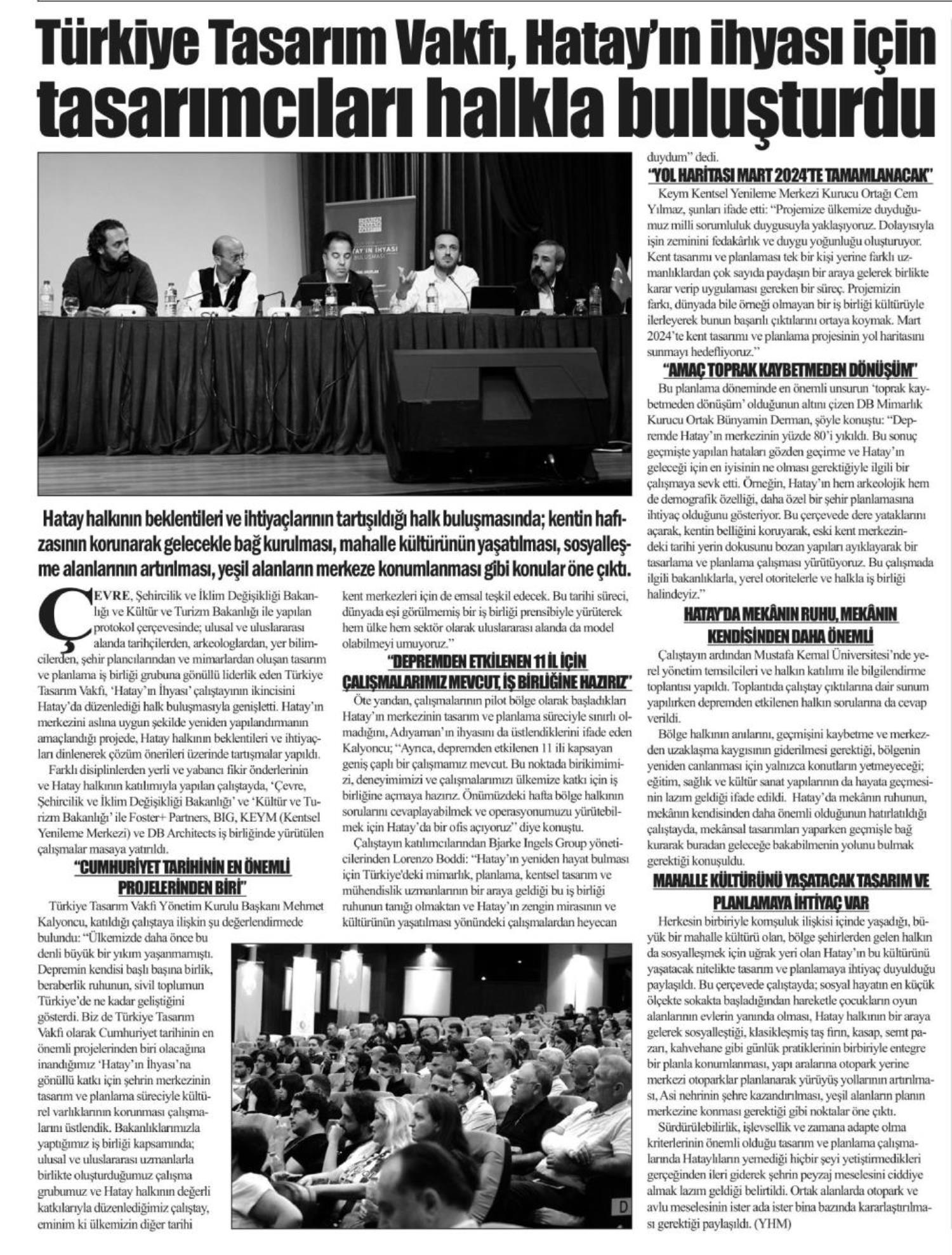
The Türkiye Design Foundation (TTV) continues its work on the revival of Hatay, which was severely affected by the February 6 earthquakes. As part of the work carried out under the protocol with the Ministry of Environment, Urbanization and Climate Change and the Ministry of Culture and Tourism, the design and planning team of national and international experts met with the people of Hatay.
At the public meeting held in Hatay, local residents’ expectations and needs regarding the city’s reconstruction were discussed. Prominent topics included preserving Hatay’s urban memory, building a strong link between past and future, keeping neighborhood culture alive, increasing social spaces and bringing green areas into the city center.
Hatay’s Future Is Being Planned With Public Participation
Turkish and international experts from different disciplines are taking part in the work, which the Türkiye Design Foundation carries out on a voluntary basis. In a process involving urban planners, architects, archaeologists and scientists, the aim is to redesign central Hatay in keeping with the city’s historical and cultural identity.
Mehmet Kalyoncu, Chairman of the Board of the Türkiye Design Foundation, emphasized that the work is not merely a physical reconstruction project. Stating that importance is placed on protecting cultural assets in the design and planning of Hatay’s historic city center, Kalyoncu said the collaboration model created by bringing together different areas of expertise could also set an example for other historic cities in Türkiye.
Kalyoncu also stated that the work is not limited to Hatay and that they take a broad perspective covering all 11 provinces affected by the earthquake.
The Goal: Transformation Without Losing Land
Another key aim of the work was to transform Hatay while preserving its existing urban fabric and historical characteristics. Bünyamin Derman, Co-Founder of DB Architecture, recalled that most of the buildings in central Hatay were destroyed in the earthquake and stressed that the new planning must not break with the city’s past.
The planning process aims to re-evaluate the Asi (Orontes) River and stream beds, address elements that disrupt the fabric of historic buildings in the city center, and preserve the region’s archaeological, demographic and cultural characteristics.
Neighborhood Culture and Social Life Will Be Preserved
At the public meeting, the people of Hatay also shared their expectations for the city’s future. It was noted that local residents are particularly concerned about losing their past and memories, moving away from the city center and the disappearance of existing neighborhood culture.
Accordingly, sustaining neighborhood culture was addressed as a key theme in the new planning. The aim is to integrate many elements into the neighborhoods, from children’s playgrounds and social gathering spots to everyday places such as bakeries, butchers, local markets and coffeehouses.
Other priorities include moving car parks underground wherever possible, increasing pedestrian access, bringing the Asi River back into city life and giving green spaces a stronger place in the city center.
The Hatay revival work led by the Türkiye Design Foundation sets out a comprehensive urban planning approach that aims not only to rebuild structures but also to preserve Hatay’s history, culture, social life and urban memory and pass them on to future generations.