A Scientific Touch to Hatay’s Reconstruction
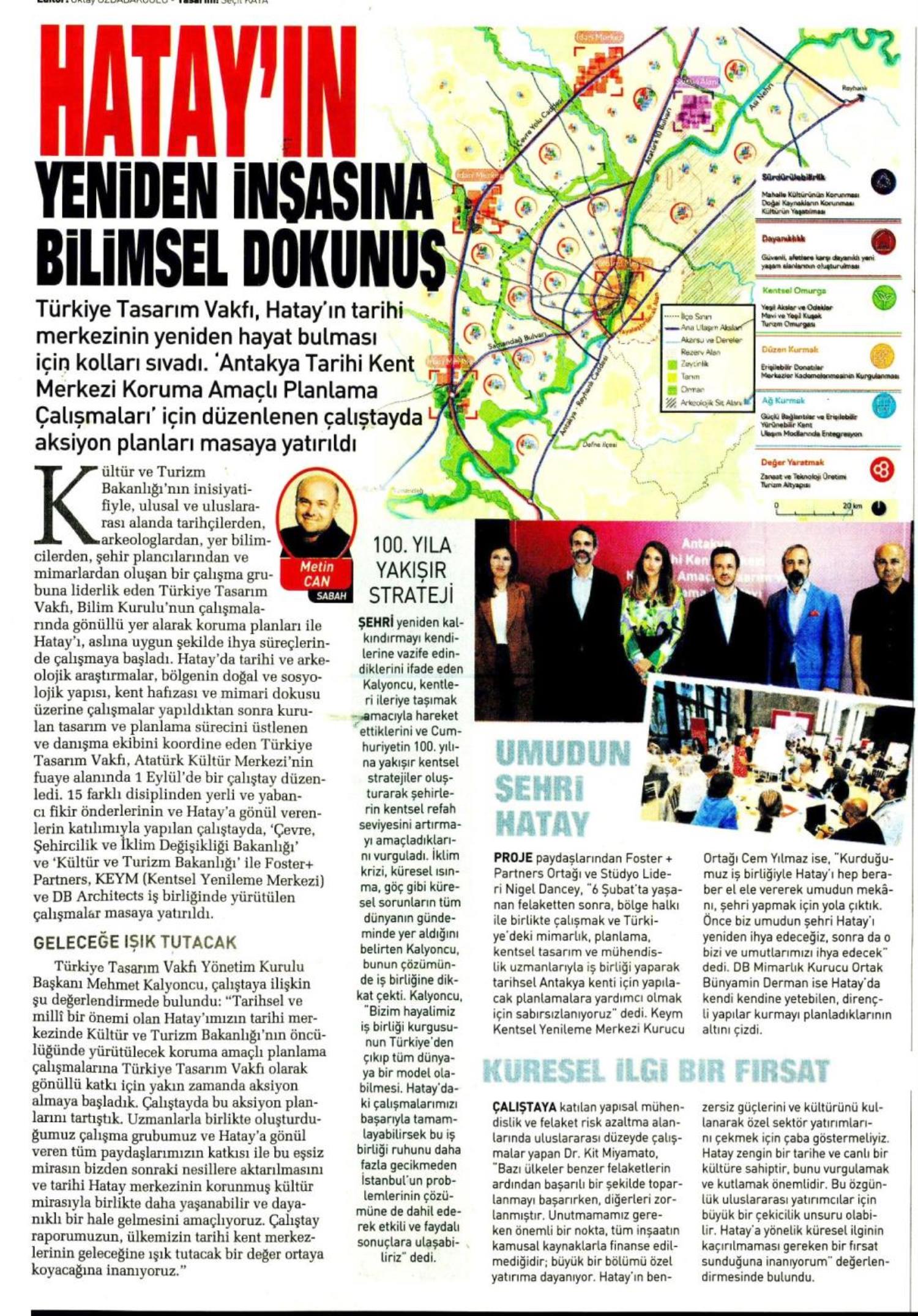
The Türkiye Design Foundation has taken another important step in its work to restore the historic city center of Hatay, which suffered great destruction in the February 6 earthquakes. At a workshop held for the “Conservation-Oriented Planning Studies for the Historic City Center of Antakya”, the conservation and action plans prepared for the city’s future were evaluated.
In the process, carried out on the initiative of the Ministry of Culture and Tourism, experts from different disciplines came together, from historians and archaeologists to earth scientists, urban planners and architects. In the work, to which the Türkiye Design Foundation’s Scientific Committee contributed on a voluntary basis, historical and archaeological research on Hatay, the region’s natural and sociological structure, urban memory and architectural fabric were addressed together.
Hatay’s Historical and Cultural Heritage Will Be Preserved
One of the main goals of the work is not only to physically rebuild Antakya but also to pass on to future generations the cultural identity the city has carried from the past to the present.
Mehmet Kalyoncu, Chairman of the Board of the Türkiye Design Foundation, stated that they contribute voluntarily to the conservation-oriented planning work in the historic center of Hatay, a city of historical and national significance. Kalyoncu said they aim for the plans prepared by the working group of experts to help the city become more livable and resilient together with its preserved cultural heritage.
The outcomes of the workshop are intended to serve as a guide not only for Hatay but also for the future of other historic city centers in Türkiye.
An Urban Strategy Worthy of the Republic’s Centenary
Pointing out that a long-term urban planning approach must be adopted in Hatay’s reconstruction, Mehmet Kalyoncu emphasized the importance of developing urban strategies worthy of the 100th anniversary of the Republic.
Key themes of the approach include sustainability, resilience, the urban backbone, transportation, open and green spaces, and the protection of natural resources. The aim is to plan the city with an understanding that responds not only to today’s needs but also to the quality of life of future generations.
Kalyoncu also stated that the collaboration model to be established in Hatay could serve as an example for other cities in Türkiye and could later be used in work addressing the problems of large cities such as Istanbul.
“Hatay, the City of Hope”
National and international architecture, planning, urban design and engineering teams are working together on the project. Nigel Dancey, Head of the Middle East Studio at Foster + Partners, highlighted the importance of working with local people after the disaster and contributing to a comprehensive planning process for historic Antakya.
Cem Yılmaz, Co-Founder of the KEYM Urban Renewal Center, stated that the “Hatay, the City of Hope” approach lies at the heart of the project, and that Hatay’s revival will be achieved through a shared spirit of solidarity and collaboration.
Bünyamin Derman, Co-Founder of DB Architecture, said the aim is for Hatay to be built on self-sufficient and resilient structures.
While the workshop drew on the experience of international experts, it was emphasized that Hatay’s historical and cultural richness is an important asset in the reconstruction process. Through the work coordinated by the Türkiye Design Foundation, the aim is to restore Hatay as a city that preserves its past, is more resilient to disasters and is ready for the future.