Mehmet Kalyoncu: “We Need Conscientious Cities”
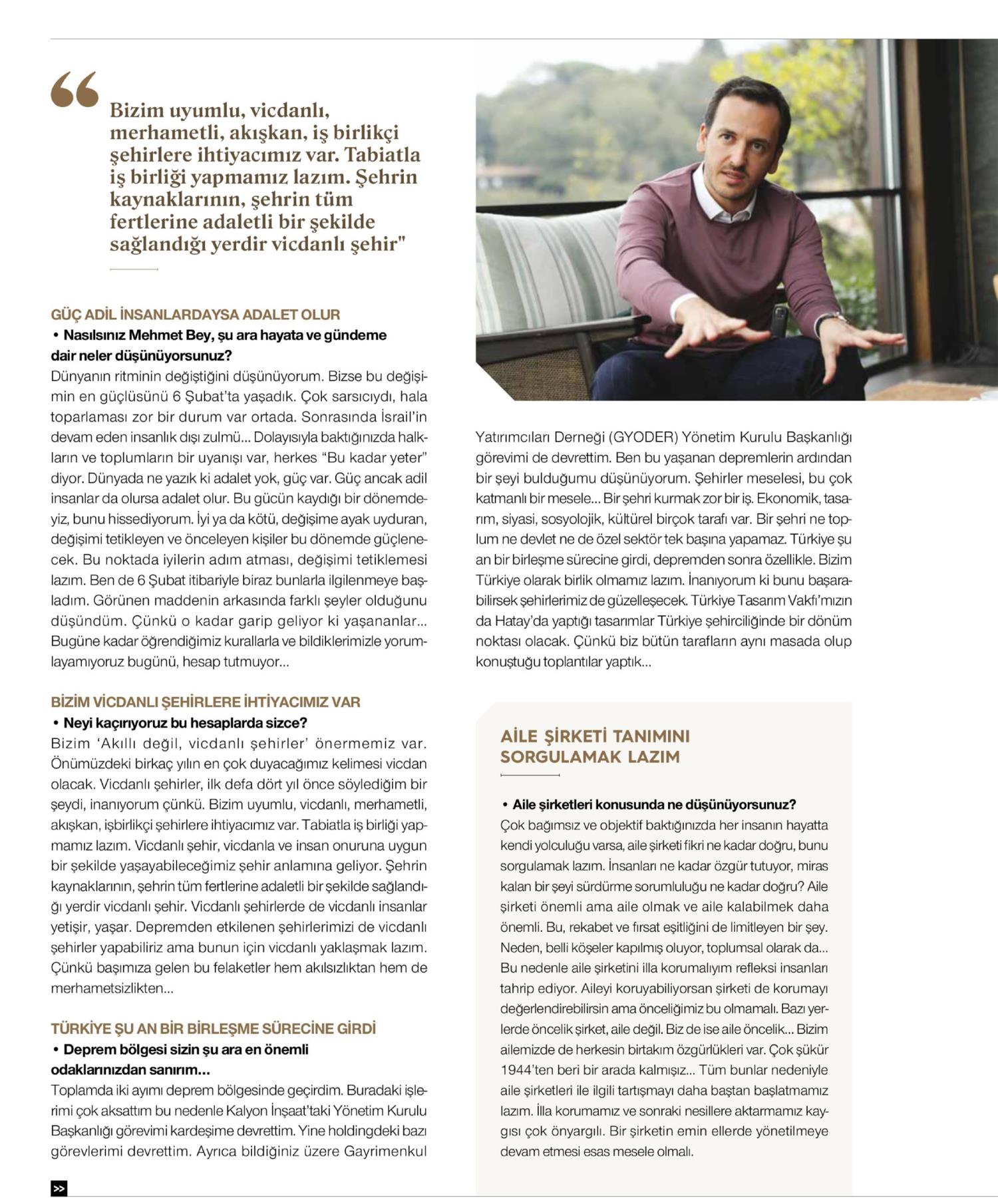
In an interview with Platin magazine, Mehmet Kalyoncu shared his views on many topics, from the social dynamics that changed after the February 6 earthquakes to the future of cities, and from the concept of justice to the work of the Türkiye Design Foundation. One of the main themes Kalyoncu focused on was the concept of the “conscientious city.”
Stating that the world is going through a major period of change, Kalyoncu says that, for Türkiye, the February 6 earthquakes were one of the turning points where this change was felt most severely. He points out that, in their aftermath, not only buildings but also the ways we build cities and live together must be rethought.
“Justice Prevails When Power Lies With Just People”
According to Kalyoncu, there is a major debate on power and justice in the world today. At a time when power is increasingly centralized, who holds this power and how it is used is of great importance.
Emphasizing that justice is connected not only to rules but also to people’s conscience, Kalyoncu believes that people who keep pace with change and steer it in the right direction should be empowered.
Stating that he has directed a large part of his work to the earthquake zone since February 6, Kalyoncu notes that the scale of the destruction has made it essential to rethink our approach to urban planning.
What Is a Conscientious City?
“Conscientious cities” lie at the heart of Mehmet Kalyoncu’s approach to urban planning. In his view, the cities of the future should not simply be places equipped with smart technologies; they should also be harmonious, compassionate, fluid and collaborative.
Kalyoncu defines the conscientious city as an urban model in which people can live in harmony with one another and with nature. Ensuring that the city’s resources reach all residents fairly is also one of the fundamental conditions of this model.
Saying “We need to collaborate with nature,” Kalyoncu regards nature not as something that stands in opposition to urban planning, but as an inseparable part of the city.
Collective Wisdom in Post-Earthquake Urban Planning
Describing how he has focused on his work in the earthquake zone, Mehmet Kalyoncu stresses that building a city is a multi-layered process. He states that many different factors, from economics and design to politics, sociology and culture, must be considered together.
According to Kalyoncu, neither the state nor the private sector can carry out urban planning on this scale alone. Stating that Türkiye needs a process of unity and collaboration after the earthquake, Kalyoncu highlights the importance of bringing different stakeholders around the same table.
Regarding the Türkiye Design Foundation’s work in Hatay as a key example of this approach, Kalyoncu believes that an urban planning model in which different disciplines and parties act together could mark a new turning point for Türkiye.
The goal of this approach is not only to rebuild the cities damaged in the earthquake, but to create cities that are fairer, in harmony with nature, sustainable and people-centered.