Hatay’s Face to Be Renewed with a $1.3 Billion Project
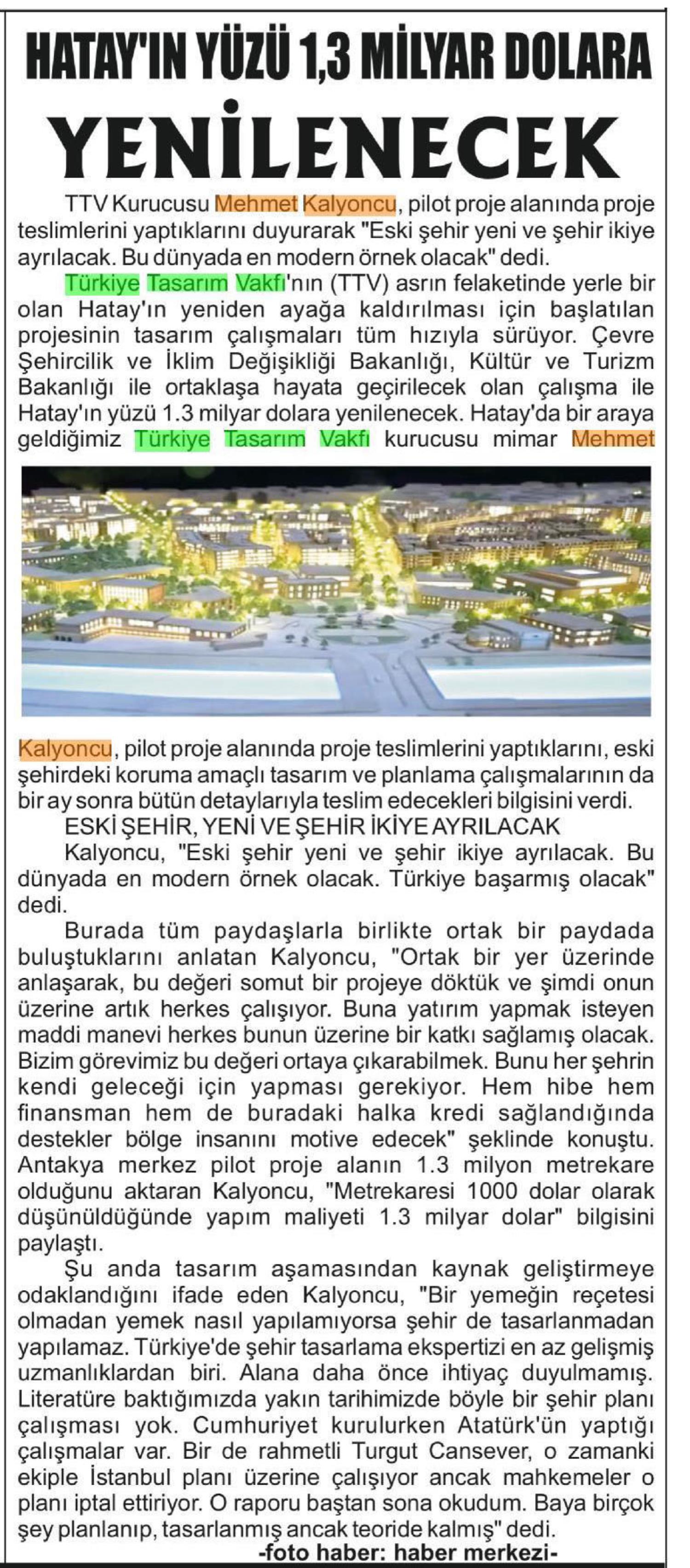
Design and planning work continues under the Hatay Revitalization Project, carried out to restore Hatay, which suffered great destruction in the February 6 earthquakes. The project, led by the Türkiye Design Foundation (TTV), is being implemented in cooperation with the Ministry of Environment, Urbanization and Climate Change and the Ministry of Culture and Tourism.
Architect Mehmet Kalyoncu, Founder of the Türkiye Design Foundation, stated that design work in Hatay’s pilot project area has reached an important stage, and that the new city and the historic urban fabric will be addressed with different approaches.
The Old City and the New City Will Be Planned Together
Preserving the city’s historical identity stands out as one of the priorities in Hatay’s reconstruction. Within the project, conservation-oriented design and planning is being carried out in the old city, while the aim in the new city is to create a modern urban model that meets contemporary needs.
Mehmet Kalyoncu stated that they aim for the urban planning approach developed for the new Hatay to rank among the modern examples in the world. Emphasizing that the project has been shaped through the joint work of different stakeholders, Kalyoncu said the value created is intended to make a long-term contribution to Hatay’s future.
A 1.3 Million Square Meter Pilot Area in Antakya
The pilot area in Antakya’s city center is one of the key parts of the project. Comprehensive design and planning work is being carried out for the area of approximately 1.3 million square meters.
According to Kalyoncu, based on a construction cost of approximately $1,000 per square meter, the total construction cost of the pilot project is projected to be around $1.3 billion.
On the financing side, the focus is on bringing together different sources and developing models that support local people’s participation in the reconstruction process.
Needs-Based Urban Design for Hatay
In redesigning Hatay, it is important not only to construct new buildings but also to correctly identify the city’s real needs. The planning process aims to consider the city’s historical structure, its social life and the needs that may arise in the future together.
Pointing out that urban design is a comprehensive field of expertise, Mehmet Kalyoncu stresses the importance of developing work in this field in Türkiye. The plan prepared for Hatay also aims to draw on past urban planning work and put forward a model suited to today’s conditions.
The Historic Fabric Will Be Preserved in Reconstruction
Revitalizing the historic urban fabric damaged in the earthquake is also among the project’s key themes. While restoration and redesign options are being assessed according to the condition of existing buildings, the aim is to preserve the authentic identity of the historic city center.
The goal in rebuilding Hatay is not simply to restore the pre-earthquake built environment, but to give the city’s future a new direction by creating a safer, more modern city that preserves the traces of the past.
With its 1.3 million square meter pilot area and projected construction cost of around $1.3 billion, the Hatay Revitalization Project stands out as one of the most comprehensive urban planning efforts for Hatay’s future.