Hatay and Adıyaman to Be Redesigned by 39 Turkish and International Architects
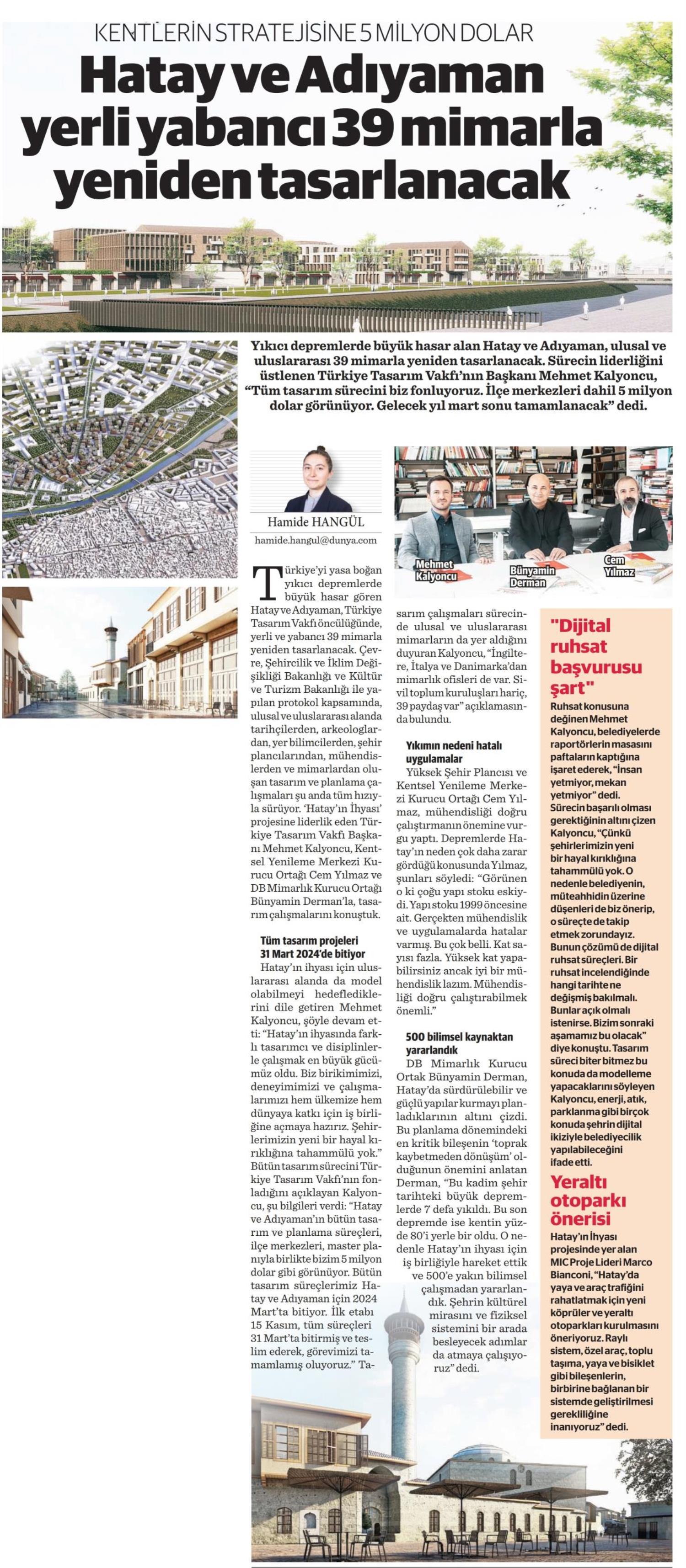
A large team of national and international experts is taking part in the design and planning work for the revival of Hatay and Adıyaman, which were heavily damaged in the February 6 earthquakes. In the project led by the Türkiye Design Foundation, 39 stakeholders from different disciplines are working together on the future of the cities.
In the process carried out under protocols with the Ministry of Environment, Urbanization and Climate Change and the Ministry of Culture and Tourism, historians, archaeologists, earth scientists, urban planners, engineers and architects are working together. The project, which also includes architecture offices from the United Kingdom, Italy and Denmark, aims not only to rebuild Hatay and Adıyaman but to prepare them for the future with a long-term, sustainable urban planning model.
$5 Million in Funding for the Design Process
Türkiye Design Foundation President Mehmet Kalyoncu stated that the work carried out for Hatay’s revival together with different designers and disciplines represents a great strength.
Stating that the project is financed by the Türkiye Design Foundation, Kalyoncu announced that a budget of approximately $5 million has been allocated for all of Hatay’s design and planning processes, including district centers and master plans.
The design work for Hatay and Adıyaman is targeted for completion by March 2024, and the resulting model is intended to serve as an example for other cities as well.
Hatay’s Historical Identity Will Be Preserved
Hatay’s historical and cultural heritage is one of the main focuses of the work. Bünyamin Derman, Co-Founder of DB Architecture, stated that the core approach in planning is “transformation without losing land.”
It is noted that Hatay has been rebuilt many times over its thousands of years of history, and this time the aim is to avoid repeating past mistakes in restoring the city.
Hundreds of scientific sources are being used to address the preservation of the city’s cultural heritage and its physical systems together. In this way, the aim is for new construction to respond not only to today’s needs, but also to Hatay’s historical fabric and the risks it may face in the future.
Lessons From the Earthquake Will Shape the New Planning
Cem Yılmaz, Co-Founder of the KEYM Urban Renewal Center, stated that faulty practices in the past were one of the main causes of the destruction in the earthquakes. He emphasized that, in the new planning process, the existing building stock, ground conditions and the way cities develop must be assessed in light of scientific data.
In addition to more disaster-resilient construction, the project is developing new models for issues that directly affect urban life, such as energy, waste, transportation and parking.
Digital Permits and New Parking Models on the Agenda
Mehmet Kalyoncu stated that digitalizing municipal permit procedures is important in the reconstruction process, noting that digital permit systems could create a more transparent and traceable structure.
Underground parking is one of the notable proposals of the project. To give Hatay a transportation system that supports walking and cycling, reduces vehicle congestion and protects the historic urban fabric, it is proposed that underground car parks be considered together with new bridges.
Through the work led by the Türkiye Design Foundation, the aim is not merely to rebuild Hatay and Adıyaman, but to redesign them as cities that are grounded in scientific data, protect their historical heritage, are resilient to disasters and can meet the needs of the future.