A New Face for Hatay: Post-Earthquake Reconstruction Project
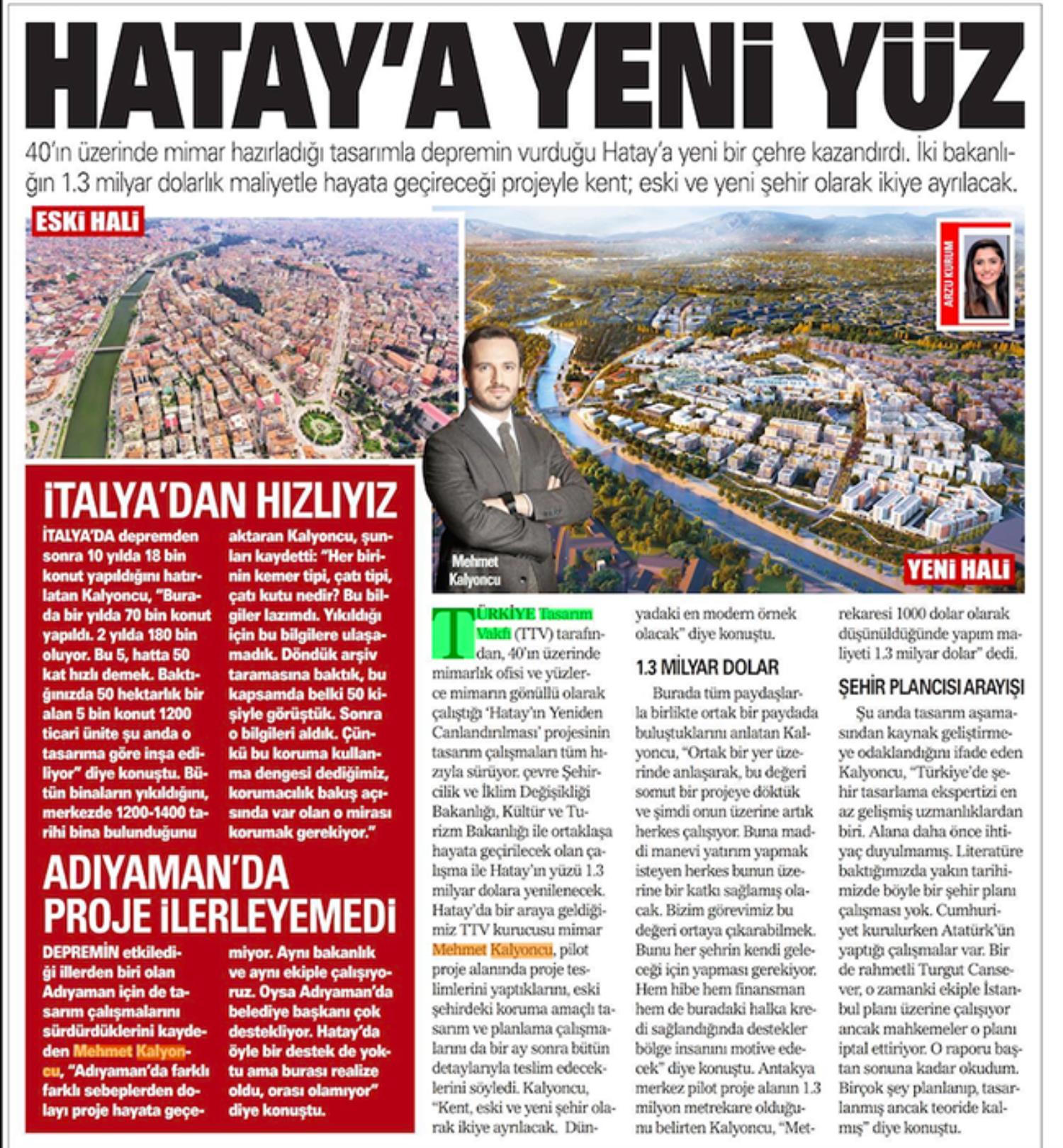
Comprehensive urban planning and design work is under way to restore Hatay, one of the cities hit hardest by the February 6 earthquakes. Led by the Türkiye Design Foundation (TTV) and prepared with contributions from more than 40 architecture offices and hundreds of architects, the “Revitalization of Hatay” project aims to create a modern and resilient urban structure while preserving the city’s historical identity.
The project, planned to be implemented in cooperation with the Ministry of Environment, Urbanization and Climate Change and the Ministry of Culture and Tourism, is reported to reach an investment of approximately $1.3 billion.
Hatay Will Be Planned as an Old City and a New City
According to architect Mehmet Kalyoncu, Founder of the Türkiye Design Foundation, the city will be addressed in two distinct parts during Hatay’s reconstruction: the “old city” and the “new city”.
One of the project’s main goals is to preserve the pre-earthquake historical fabric and Hatay’s distinctive architectural character. Accordingly, conservation-oriented design and planning will be carried out in the old city, while contemporary urban planning approaches are envisaged for the new city area.
The work focuses not only on how new buildings will be constructed, but also on how Hatay’s inherited architectural heritage can be kept alive. Archival research has been carried out to identify the features of the buildings destroyed in the earthquake, and information has been gathered on the region’s traditional building types.
A 1.3 Million Square Meter Pilot Area in Antakya
The project’s pilot area in central Antakya is reported to cover approximately 1.3 million square meters. On this large area, plans include housing as well as commercial units and other functions that will support urban life.
Emphasizing that reconstruction is not limited to physical construction, Mehmet Kalyoncu highlights the importance of involving local people in the process. The project’s core approach is built on revealing the city’s own values and developing an urban model suited to Hatay’s needs.
Protecting Historical Heritage Is a Priority
The city’s historical heritage is one of the most important issues in Hatay’s reconstruction. Noting that there were many historic buildings in central Antakya before the earthquake, Kalyoncu states that this heritage must be protected during reconstruction.
For this reason, the design work has examined the characteristic features of past buildings, such as arches, roofs and façades, and the data obtained is being taken into account in the new planning process.
While modern urban planning practices around the world have also been studied, the aim is to develop an original approach suited to the region’s historical, cultural and social structure rather than copying another city’s model for Hatay.
This comprehensive work for Hatay’s reconstruction stands out as one of the major projects bringing together post-earthquake urban planning, the preservation of historical fabric and modern city planning under one roof.